L'un de mes endroits préférés pour sortir était le Dancers, un club situé à l'intersection des rues Harrison et Second. C'était un espace sombre où des lumières colorées clignotaient au rythme d'un battement industriel constant, créant une atmosphère de sensualité incontournable, avec des gens qui dansaient sur le comptoir du bar. J'avais maladroitement demandé à plusieurs jeunes femmes de danser avec moi, mais à chaque fois, elles avaient refusé. Juste au moment où le découragement s'installait, j'ai repéré une femme séduisante près de la piste de danse, appuyée contre un pilier, de longs cheveux bouclés cascadant sur ses épaules nues, et ses grands yeux marron encadrés par des sourcils épais et parfaitement soignés. En m'approchant d'elle, je me préparais à un autre refus, car elle aussi risquait de décliner ma demande. Je lui ai donc posé la question cliché : « Tu viens souvent ici ? » À ma grande surprise, cela a engagé la conversation. Et il s...
 |
| King Willem-Alexander and his mother Princess Beatrix smiling at the people who pay for their palaces |
Behind the Democracy: How the Dutch Monarchy Exercises Silent Control Over the Government
According to Article 1 of the Dutch Constitution, every individual in the Netherlands should be treated equally under the law. However, there is one family who is above the law: the superior royal Dutch family. This is a huge contradiction in Dutch society and culture. The Dutch legislature should either abolish Article 1 or the monarchy and revert back to a republic, which the Netherlands originally was.Not only are the Dutch royals above the law, they run over the rights of the Dutch people by taking their money. And then the King lectures the Dutch people about "equality" and "diversity" as Dutch politicians, elected by the Dutch people, sit there silently while he does. In the Netherlands they call that "democracy."
King Willem-Alexander is one of the richest men in the world. His wealth is estimated to be over $20 billion but it is probably much more than that. And the Dutch monarchy pays no taxes. If any citizen doesn't pay their taxes, they go to jail.
But it gets worse. Not only do the Dutch royals not pay taxes, they take over a hundred million euros in "subsidies" each year. This is paid for with the taxes of the Dutch people. It is a dirty quid pro quo between corrupt politicians and the Dutch monarchs.
Also the notion that the Dutch monarchy is a politically passive institution with limited constitutional powers is perhaps the biggest and longest lasting cultural myths in the Netherlands. Or should I say Kingdom of the Netherlands?
You won't read about this because -- unlike the British tabloids -- the Dutch media rarely write critical articles about their own monarchy (but they love trashing the British monarchy). The Dutch monarchy own the Dutch legacy media.
Rarely in the Netherlands will you find a news article raising questions about the enormous wealth and political influence of the monarchy. Nor will you find a news article challenging the morality of justifying a monarchy: the idea that some people are superior by birth because they have superior genes or superior DNA, i.e., the whole supremacy bloodline theory and "Übermensch" ideology that the German philosopher Friedrich Nietzsche created and that Adolf Hitler was so fond of.
Nor will you find a public opinion poll with the question: "Should the Netherlands return to being a republic?" These questions are rarely asked by the Dutch legacy media -- or by Dutch politicians.
It is speculated that the Dutch royals own stock in the mainstream Dutch media companies such as De Telegraaf (which is owned by Mediahuis) and have royal connections with their board members, such as the Dutch state media, the NOS, who relies on its funding from "the King's government." Because the way politics works in the Netherlands is as follows:
The politicians tax the productive Dutch people and re-distribute the money directly and indirectly to the Dutch monarchy. The monarchy then buys stocks in Dutch multinational companies and the Dutch Ministry of Foreign Affairs promotes these companies with international trade deals in which King Willem-Alexander and Queen Maxima actively participate, known in Dutch as "handelsmissies."
The Dutch Royals fly abroad with the Ministry of Foreign Affairs team to negotiate trade deals. It is a huge conflict-of-interest because the Dutch government is not negotiating on behalf of the Dutch people, but on behalf of the Dutch monarchy and all their multinational investments. It is collusion between Big Monarchy and Big Business.

The Dutch Ministry of Foreign Affairs always works hard for the Dutch people
More often than not, when Dutch politicians leave public office, and if they promoted the subsidies and business interests of the Dutch Royals, a good job awaits them, such as a CEO position with one of the Dutch multinational companies they own stock in. Or the King Willem-Alexander can appoint them to other government positions as well, such as Commissioner of the King positions (similar to a Governor position). There are so many lucrative jobs that King Willem-Alexander can give them. It's a dirty game of quid pro quo.
The Dutch Ministry of Foreign Affairs always works hard for the Dutch people
More often than not, when Dutch politicians leave public office, and if they promoted the subsidies and business interests of the Dutch Royals, a good job awaits them, such as a CEO position with one of the Dutch multinational companies they own stock in. Or the King Willem-Alexander can appoint them to other government positions as well, such as Commissioner of the King positions (similar to a Governor position). There are so many lucrative jobs that King Willem-Alexander can give them. It's a dirty game of quid pro quo.
Some of these companies that the Dutch Monarchs have shares in are Royal Dutch Shell, Unilever, KLM, Heineken, Philips, AkzoNobel, but there are so many more. Nobody really knows because what stocks the Royal Dutch family holds is considered a "private matter" even though it is all paid for with taxpayers' money.
And then the Dutch monarchy receives an annual allowance of 400 million euros, but this does not include many other expenditures and unlisted benefits. Why should such a wealthy family not paying taxes qualify for "subsidies?"
The annual budget of the Ministry of Foreign Affairs for example is 13 billion euros. Both of these expenses are paid for by the Dutch taxpayer but the benefits, directly and indirectly, are for the monarchy.

Then Prime Minister Rutte working hard for the Dutch working class
When elected members of the Dutch parliament are sworn in they have to take a loyalty oath to the King and his monarchy, not the people who elected them. The cabinet members are sworn in by King Willem-Alexander himself at the royal palace. Yes, they must come to him, climb up the many stairs to the palace to present themselves to Him to be sworn in by Him, His Majesty -- even though they were elected by the people. This is a Dutch tradition and religion.
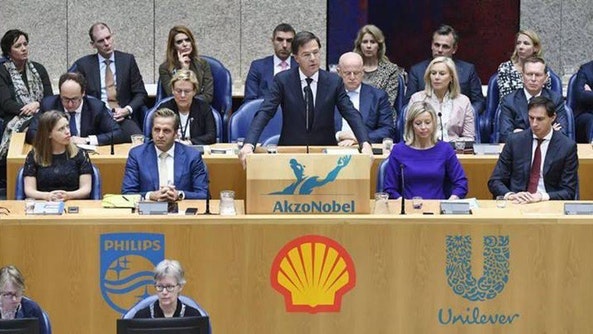
Then Prime Minister Rutte working hard for the Dutch working class
When elected members of the Dutch parliament are sworn in they have to take a loyalty oath to the King and his monarchy, not the people who elected them. The cabinet members are sworn in by King Willem-Alexander himself at the royal palace. Yes, they must come to him, climb up the many stairs to the palace to present themselves to Him to be sworn in by Him, His Majesty -- even though they were elected by the people. This is a Dutch tradition and religion.
Thereafter these ministers and their family members receive many royal palace invites and gifts. Besides owning many palaces, the Dutch royals also have lots of real estate around the world, private planes, yachts, and many luxurious accommodations, such a blessing for vacationing ministers or members of the parliament. Who could say no to that? It's really amazing.
The Dutch royals can make any member of the parliament and their family feel like royalty themselves. Suddenly you and your family are at the pinnacle of Dutch high society.
Therefore, you will rarely find a Dutch politician challenging the existence, justification or expenditure of the monarchy. And each year the so-called people's representatives, the politicians, keep forking more of the Dutch people's money to the Dutch royals -- it's a sort of reverse Robin Hood.
For example, as a student, Princes Amalia, like her sisters, receives an annual 1.6 million euro tax-free "salary." But no Dutch politician will challenge this and will sit in silence and clap like a seal when King Willem-Alexander lectures the Dutch people about "equality," and "diversity."
The Dutch monarchy is the elephant in the room of Dutch politics. Or in American vernacular you could say that the Dutch monarchy is "the swamp" or "the deep state" of Dutch politics.
The political influence of the Dutch monarchy is so strong, that even then Prime Minister Mark Rutte, who was elected on a conservative platform, tossed his party's platform ( from the VVD party) overboard and instead adopted King Willem-Alexander's WEF agenda.
The Netherlands is an absolute monarchy parading as a democracy.
 |
| When a picture is worth a 1000 words |
 |
| Queen Maxima fighting hard or the Dutch working class at the WEF |
 |
| The Dutch Royals also enjoy lecturing the Dutch people about climate change |
 |
| Dutch "democracy" parading in China |
 |
| The "Palace of Justice" |